 Chelsea AI Ventures
Do you know if your website and marketing work?
Most small businesses have a website. Far fewer can say what it does for them. We loaded 452 small-business home pages ourselves, checked what each one measures, and set the result beside the official statistics, the privacy rules and the arithmetic of testing. The highlights are below. The 14-page paper has the rest.
Highlights
- 38.5% of the small-business sites we loaded ran no analytics tool we could detect. That is 174 of 452 sites (95% interval 34.1 to 43.1). By region: 48.5% in the EU sample, 40.4% in the UK and 26.8% in Australia. A further 4.9% loaded only a tag manager or an advertising pixel. The sites are independent local businesses in four trades that list a website in one open dataset, so the figure says nothing about businesses without a website.
- Owning a website is common. Analysing it is not. Official surveys put website ownership at 79% of EU enterprises with ten or more staff (2025), 78% of UK businesses (2025 to 2026) and 55% of Australian employing businesses (2024 to 2025). In Australia, 10% of businesses collected or analysed data to inform decisions.
- Consent rules cost data. One vendor benchmark found that sites with a legally compliant consent banner lose an average of 60% of their recorded visits. The vendor does not publish the sample size, so read it as a direction, not a forecast.
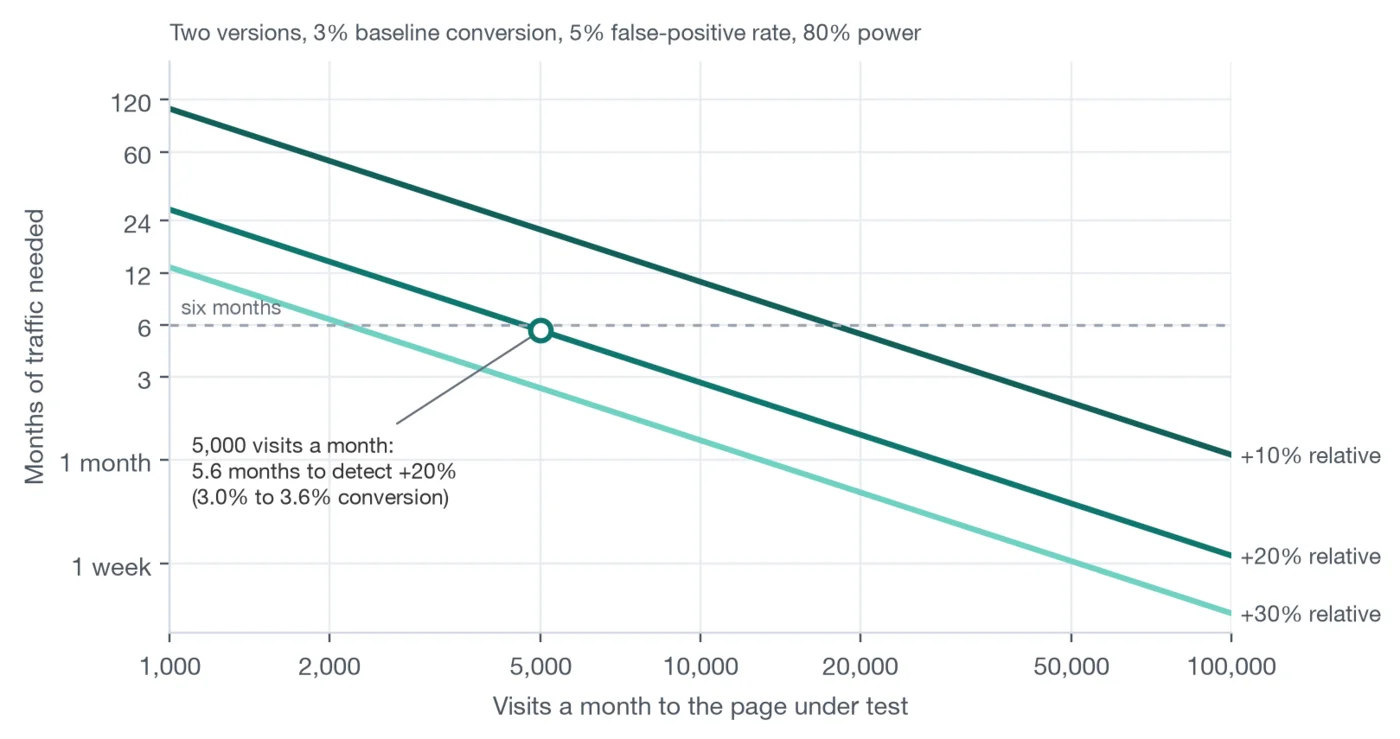
- A/B testing needs more visitors than most small sites have. Detecting a 10% relative lift on a 2% conversion rate takes about 161,000 visitors across both versions. At 1,000 visits a month that is 13.4 years. Only about a third of tests at Microsoft improved the metric they targeted.
- A cheap lead is not always a good lead. In our worked example (invented numbers, labelled as such), the channel with the lowest cost per lead produced no gross profit after ad spend, and the channel with the highest cost per lead returned £4 of gross profit for each £1 spent. Only a lead ledger that carries the source through to the invoice shows it.
- Speed of reply matters. A Harvard Business Review study of 1.25 million leads found that firms contacting a lead within an hour were nearly seven times as likely to qualify it as firms that waited an hour longer.
Where the sample stands
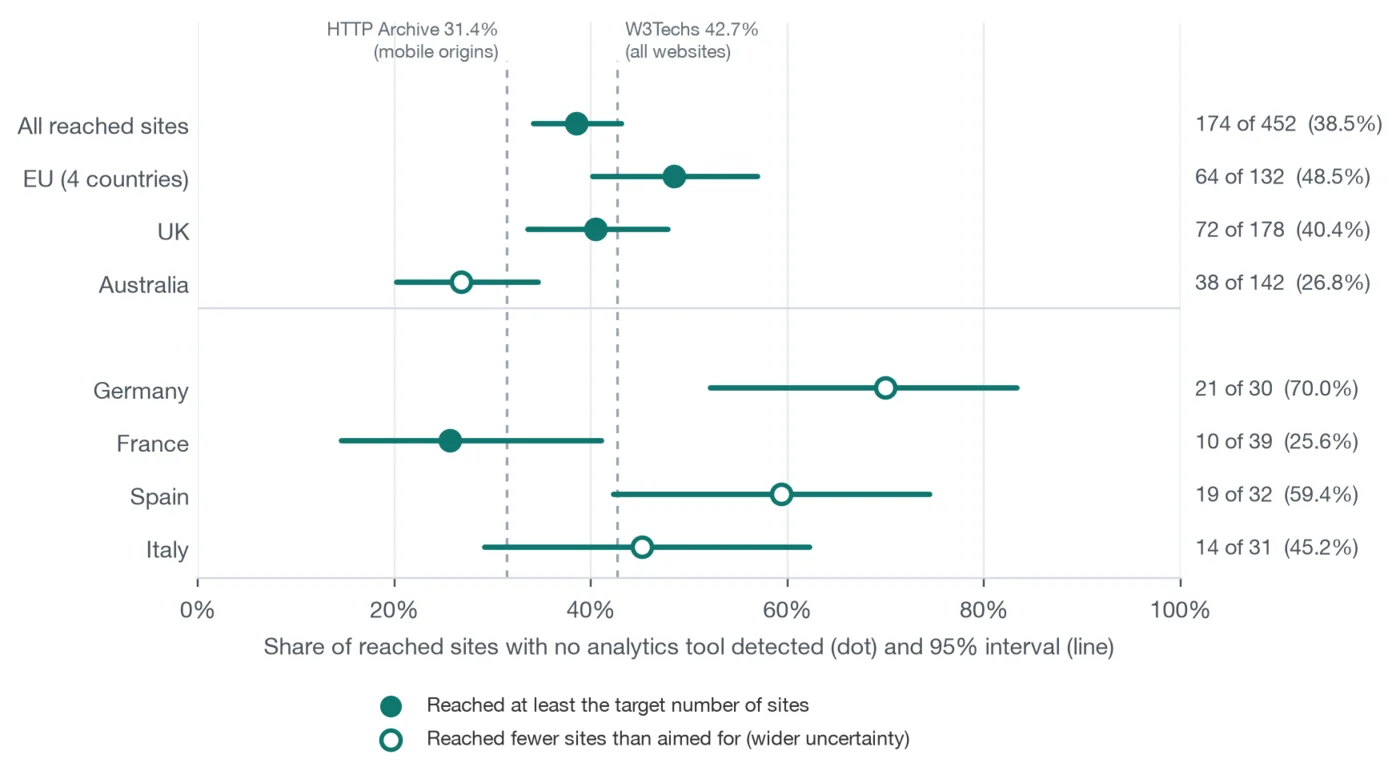
Germany, Spain and Italy each fell below the 35 reached sites we aimed for, so the EU figure is a blend and the country figures carry wide intervals. Where the page source named a Google tag, the network requests agreed on 181 of 194 sites (93.3%). A tool that loads only after a click, or runs on the server, is missed, so "none detected" means we found none, not that the site measures nothing.
Why classical testing is out of reach
What to do first
Keep a spreadsheet that records each lead's source and, later, the gross profit of the job it became. Do this before buying more marketing software or advertising. The full paper gives the five-step method, ten steps for the next twelve months with rough costs, and a tool-by-tool table with the prices we could confirm.
Read the full report
14 pages with 44 sources: how we measured, the consent and privacy rules in the EU, the UK and Australia, the sample-size arithmetic, the attribution example, the tool landscape and the twelve-month plan. Enter your email address and the PDF downloads here.
Thanks. Your report is ready to download.
Download the report (PDF)Want a second pair of eyes on your site?
We audit a site's measurement, forms and speed, and set up measurement that does not depend on guesswork. Book a free scoping call.